After over two years, I got to go to an in-person Khaki Tours walk again. This one, "Sacred Banganga", was in the Walkeshwar area, near Malabar Hill.
We convened at Walkeshwar bus depot, and Ninad the guide gave a brief history of that area of Mumbai. The area was named "Malabar" simply as an extension of the west coast - and those who looted British ships called Malabar pirates. When the Governor shifted his residence from Parel to Malabar hill, his rich associates moved as well, and even today the area is noted for Raj Bhavan and other generally affluent residents. (Apparently Raj Bhavan is open for tours, including an underground bunker - future post sorted!) The area used to be a hunting ground.

Then it was time to see the temples. The first was a shrine of Khandoba, a form of Siva. This deity is an example of syncretic beliefs - he has five wives, all from different communities, including a Muslim, so the worship and festivals would involve everyone. A large Khandoba temple exists in Jejuri, in Pune district, incorporating elements of Islamic architecture (some say it was to look like a mosque from afar to avoid being razed by invaders).
We then turned into the narrow streets leading to Banganga tank. There is an office of Mangaldas Nathubai trust - the same Mangal of Mangal Market. In some of the building complexes are samadhis of saints.

The Jabreshwar temple is in one of these narrow, sloping streets. The name is linked to the word zabardasti - the street was taken by force and the temple built by Ramdas Nathubai.


We then descended on Banganga tank itself. By the tank were many towers with grooves for lamps. The story goes that Lord Rama, while on his exile, met Rishi Gautama here. When the Rishi was thirsty, Rama shot his arrow at the ground and drew water — hence, ban-ganga. The water is considered as holy as Ganga water. (Fellow walk attendees' reaction: polite smiles and nods.)
The guide later informed us that the band Coldplay had visited this area to shoot a music video, and so had Prince William and Kate Middleton. (Fellow walk attendees' reaction: wows and gasps!)

It was time to peek into just a handful of the many, many shrines around the perimeter of the tank. The first was a Parashuram shrine. This was built in the 60s. Next door is the residence of the Bhansali family (of Sanjay Leela).

Also in the area is a Punjabi Dharamsala, site of Bollywood's famous Holi parties.
The tallest spire is of the Rameshwar temple. This and the Ganapati temple just opposite were built by Pathare Prabhu families. Adjacent is the Lakshmi Narayan temple which has elements of Gujarati architecture.

The Walkeshwar temple, which gives the area its name, is actually vAlukA (sand) + ISvar — the lingam was fashioned out of sand by Rama. (The Marathi word for sand is also vALU / वाळू.) The current temple structure was built by Rama Kamti in the 18th century.
There is a Vitthala temple, but with the idol in the form of Srinathji from Rajasthan. There is a Kashi Math (below) managed by a Gauda Saraswata Brahman trust. There is a Hanuman shrine where he is holding a dagger. It would take hours to see everything in all its detail.

This (below) was the house of Pandit Vishnu Narayan Bhatkhande, who is responsible for the Bhatkhande lipi in Hindustani music and the thaat classification of ragas. In another world, this would be a museum.
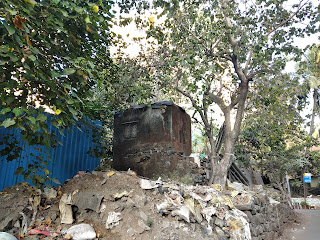
Also by the tank are other interesting sites: a Hindu burial ground, for certain communities and cases where the dead are to be buried and not cremated. There is a dhobi ghat with a freshwater well, even though we are right by the sea.
Descending the steps into the tank, one can see hero-stones. Tucked behind another structure is a stone from the original Walkeshwar temple. Geese and cats abound. The source is shaped like the source of the Ganga river, Gomukh.


Another shrine (below) is that of Santoshi Maa. This relatively minor goddess was propelled to stardom of sorts by the Hindi film of the same name.

One temple we got to go inside was the Balaji temple (or Vyankatesh, as He is known here!). It is built in the Peshwai style, with space above the entrance for musicians. Above the idol is a dome, like in the Bengali style. There is a sculpture of Hanuman, this time with a bow!

Just by the tank is the Siddheshwar temple (below), built by Raghunath Rao, who was the son of Peshwa Baji Rao but never became Peshwa himself. He came to Bombay after being exiled for conspiring against his own family.

Our final stop was one more shrine on a street leading away from the tank: a Jagannath temple (below). Inside the main shrine are tiles with paintings by Raja Ravi Varma.

The temples were islands of quiet, even though outside was business as usual with people milling around and children playing. (This is probably not the case during pitru-paksha time when large crowds descend upon the tank to perform offerings to their ancestors.) The area is well worth another, longer visit!

The rough route, starting at Khandoba (can't go anticlockwise after all :))


