Thursday, 12 September 2019

[Locality]-cha Raja's final journey

Transliteration inherently involves some loss where the new script has limitations (see: கோகுல் /kogul!) but an interesting phenomenon is when it takes on the inflections of the new language. Just within a few hundred metres of where I am, you can "navy" being written as नेव्ही (nevhi) and "stores" स्टोअर्स (stoars), even when it is entirely possible to write them without the extra letters. This is indeed how they are said; the transliteration is less to do with reproducing the original word and more to do with putting down the local interpretation of it, in the local script.
-
Today marks Anant Chaturdasi, the tenth day following Vinayaka Chaturthi and the (final) day that Ganesha idols are immersed in water. For historical reasons, this event is a massive, massive event in Mumbai. Huge crowds in long lines gather to get a darshan of the deity, and still bigger crowds usher the lord through the streets on Visarjan day.
The glamour of the whole affair makes one think about how far removed the festival has become from its roots, and even from its reincarnation as a way to unite Indians under the British. What does it say about devotees' faith, if they have to insure their idol for tens of crores of rupees? More troubling to me is the willingness to spend weeks creating the idol, worshipping it for ten days and then drop it into the polluted ocean; inversely, the willingness to release Plaster-of-Paris idols painted in dangerous heavy metals into the ocean, indeed a divinity in its own right. 
To mitigate the environmental damage, the BMC introduced artificial ponds for immersion a few years ago, but the purpose is being defeated as the water is pumped untreated into stormwater drains which eventually reach the sea. 
The PoP idol remnants are crushed into smaller pieces and transported to construction companies. Surely this is a jarring fate for the idol? I wonder if this even crosses the minds of the throngs of devotees. The tradition of immersing a clay idol in a (local, natural, clean) water body holds symbolic significance, and while one aim is to probably discourage people from becoming too attached to the idol and recognising the eternal divinity... this rather warped version of that very much confuses me. 
That said, a show of celebration and devotional abandon is a beautiful thing; different cities have their version of that, and the spirit of this one is like no other.

Sunday, 1 September 2019

Museum Musings

Another interesting study in how different cities evolve different solutions to day-to-day problems: how do different bus conductors let the driver know he can move? Of course the "whistle podu" city involves the conductor blowing a whistle; in Mumbai buses, a length of string with a bell attached runs along the length of the bus, which the conductor can tug from wherever on the bus he is. (The latter seems possibly conducive to misuse but clearly it has not been a problem.)

- 

Looking like a proper tourist, replete with cap and sling bag, I finally made my first visit to the museum since moving. Hopefully the first of several - I spent two-and-a-half hours there and still covered less than half of it.


My South Indian temple/Chithra Madhavan-loving self was obviously drawn to the sculpture gallery first. There is a high representation of sculptures from Maharashtra, Karnataka and Gujarat - after all, the museum was once the Prince of Wales Museum of Western India. Hindu gods and goddesses stand in a gallery adjacent to a separate one for Buddhist and Jain sculpture. There is also a metal sculpture gallery with bronze statues as well as objects.


I found the most unique gallery to be the Himalayan art gallery. A collection of statues, paintings and other objects from the Tibetan and nearby regions, the gallery is curated with care to actually simulate the feel of the place (barring temperature!). 


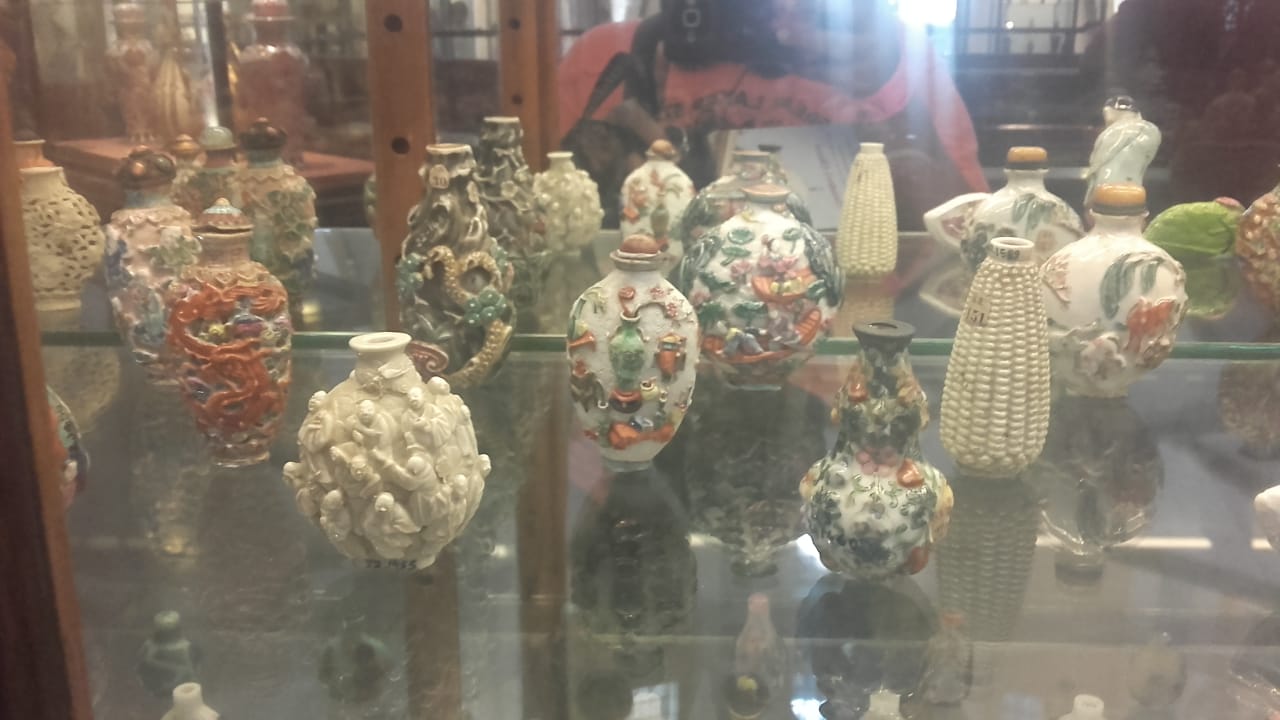
The other standout was the personal collections of Ratan and Dorabji Tata. Spanning European paintings and Oriental snuff-boxes, it was a visual treat but more so a reminder of the scale of their wealth. Was it really a coincidence that a student at Tata Institute spent an afternoon looking at the Tata brothers' belongings? 


I also visited the miniature painting and Krishna galleries. A personal favourite from the latter was a visual representation of the Madhurashtakam in praise of Lord Krishna - after all, I did listen to MS Subbulakshmi's rendition every day for a long time. 


The audio guides were definitely made for foreigners, (I'm talking explicit recommendations for things to see and buy during "your stay in India") so a lot of the information was not new. Some was though, and I do think a lot of Indians could stand to learn about the "lost wax method" and Buddhist history.  

Flora Fountain is a short walk from the museum (well, short if you can determinedly walk past the piles of second-hand books without getting distracted).


Do stay tuned for further museum visit logs! There was an entire block I didn't visit. Until then, a virtual high-five for anyone who can spot my reflection in one of the photos. 

Sunday, 11 August 2019

Walk the Straight Path

"Kanchipuram Dhokla", my incredulous eyes read as the ticker goes by a fourth time. A snack shop proclaims this with confidence. I have not heard of this apparent delicacy in my twelve years of living in a small town near Kanchipuram, called Chennai. The closest thing I can think of is Kanchipuram Idli, whose resemblance to dhokla ends with both having holes. You know how they say people discover themselves when they travel? It seems I will be discovering my home state.

- 

While Chennai celebrates Madras Day, I decided to treat myself to a bit of local history here, by attending a heritage walk in the Esplanade area. Conducted by Khaki Tours and led by a Mr Farrok, the walk wound through some old, broad streets (with relatively recently changed names!). Below are some highlights. 

"Esplanade" refers to an open ground, and the area known as Esplanade was the open ground around the Fort. Eventually, the fort became overcrowded, so the walls were torn down and the open grounds became occupied by various structures. 

Capitol Theatre, earlier Gaiety Theatre, which evolved from a drama stage to a silent movie theatre to a talkies theatre. It is the site of Dadabhai Naoroji's first - and only - stage performance, where he was booed off the stage. Who knows what turns history would have taken had he stayed in the acting business?

Another theatre, Empire Theatre, was built in the Victorian Gothic style but later remodeled to an art-deco style featuring geometric patterns.

Elphinstone Cricket Club, where Indians watched the British play cricket. (Reminds one of Champaner?) Things must have come full circle when we watched them play in Lord's last month with much enthusiasm though it wasn't an India match. Later, we saw the Bombay Gymkhana, where the first India v England Test match took place in 1933. Unlike Champaner, India lost, but the stakes probably weren't as high.

Fort Dispensary (below), built in the 1870s mainly to stock medicines for women and children and still the site of women's organisations. Notable are the triangular roofs with Mangalorean tiles. 


Bombay Gas Company, established in 1862 by the Governor-General. Interestingly, optic fibres now run where gas lines once did. Opposite stands the telephone building (below), where the telephone was brought to Bombay within six years of its invention!


Parsi Lying-In Hospital (below), founded exclusively for delivering babies, with an emphasis on hygiene and isolating the new mother in order to reduce the number of deaths during childbirth. 


Schools - the Young Ladies' School, the J.B. Petit School (below), the Cathedral School and the Alexandra Girls' school. 


The ENT Hospital, where the Bombay City Improvement Trust was founded following the Bombay Plague in the 1890s, for better development and sanitation of the northern areas that were being planned and built. 


The Esplanade Estate (above; this image shows the passage between the main house and the servants' quarters) and the Tata Palace (below). The former is now occupied by a philanthropic organisation, while the latter now houses Deutsche Bank. Both show French influences in the architecture. Esplanade Estate, guarded at the entrance by a sculpture of a St Bernard, was renovated in 2013 in a manner that preserved the spirit of the construction, and hence won a UNESCO award.


The walk concluded opposite the TCS House, earlier known as the Ralli House. The inside was completely overhauled, resulting in a building that appears to have four storeys from the outside but really has six! A board above the entrance states, in Greek, "Walk the Straight Path". This walk took a path with many turns (reconstructed below, as best as I could remember!) but I hope to do it again sometime with more leisure.


And finally here is a shot of VT/CST with clouds looming behind - exemplifies what this city is known for.


Saturday, 3 August 2019

An Aaydle Mind

A favourite anecdote of my mother's is when a friend of Tamil writer Ki. Va. Jagannathan was living in Kolkata and missing home. He accidentally trod on a stranger's foot at a marketplace. "Muttaal!" the stranger exclaimed in Tamil. "Idiot!" Instead of being offended, the Tamilian was filled with joy on hearing Tamil outside its home, even if the speaker was abusing him!

Granted, I haven't been here long, but I did have a less intense version of that experience, when I asked the cashier at the canteen whether a particular dessert was vegetarian. "Muttai", he replied. (The lexical similarity to "Muttaal" is a coincidence.) "It contains eggs." Now he was depriving me of the custard but this was somehow still exciting to hear! An unlikely friendship seems on the cards.

I have been confined to the institute campus this week due to the small fact of a thunderstorm and flood, accompanied by red-alerts and notices of the second-highest rain in July in sixty years. (We are trying to find out which of the freshers is responsible for this disruption.) Of course, this does not stop brave joggers in raincoats as I observed last week, but for newbies trying to get accustomed to Mumbai germs, it is not the most preferable welcome.

Mumbaikars do use hacks to make life more efficient, but they seem to be missing a trick with not using dabara-tumblers, or similar apparatus, although the weather seems to be doing a decent job of cooling things down. Or, it is all a ploy to make drinks last longer and conversation (and hence research collaboration) happen. 

Speaking of hot beverages, TIFR's science popularisation initiative is called Chai and Why. It took me a moment to realise that Marathis pronounce "why" to rhyme with chai! (A similar phenomenon is the mobile network Idea being transliterated as "आयडिया / Aaydia" on adverts. This does reflect how they actually say it!) Hopefully I will be able to step outside and actually attend some of their events soon.

Saturday, 27 July 2019

States of Matter

On my first day I went in complete seriousness to a Madras Cafe. A man on the next table asked for a bigger cup of sambar so he could dunk the idli in it. It hit again that this is definitely a different place. 

When did it first hit me that I was moving? Piecemeal, and mostly on Gmail. First when I sent an email to my old institute that I wouldn't be continuing there for Masters, and they replied with a thank you and all the best. Fitting, really, a crisp but kind goodbye. Then when my new institute sent me an email with the formalities I would need to complete upon arriving. Collect this from Mr Shinde, submit this to Mr Chavan, get the signature of Mr Waingankar. Oh my god, I thought, I'm moving to Maharashtra. 

India, that is Bharat, is a Union of States. So begins the Constitution of India. So began the story of independent India - leaders tirelessly convincing state after princely state to join this new country, in a whirl of hope and idealism and freedom (and bloodshed). My point is, these states began as proud countries of their own and the passage of a couple of generations will not erase that entirely. Moving to Maharashtra from Tamil Nadu is in some ways like emigrating to a new country and in some ways not. For starters, their Marathi-inflected Hindi teeters on the edge of the span of languages I speak. I make an effort to read it from billboards as my favourite cricketers smile down beside it. I did feel a bit treacherous crossing over from parched peninsula into thunderstorm territory. 

I'm already making a mental note of the things we could learn, one state to another. Signboards are bilingual if not trilingual, without fail. Waterlogging is definitely not as bad as it would be if Chennai got this much rain in this little time, nor does the rain cause an upsetting number of trees to fall. Taxis are metered!

Cultural events jostle for space in the day's papers - once the rain abates, I may have a realistic problem of plenty. 

It looks to be a promising time here. [raising wide cup of sambar] To new beginnings!

Dee-fence!

     Earlier this year, I had the good fortune to visit Toronto for two months for an academic project. In that time, I tried to take in as ...